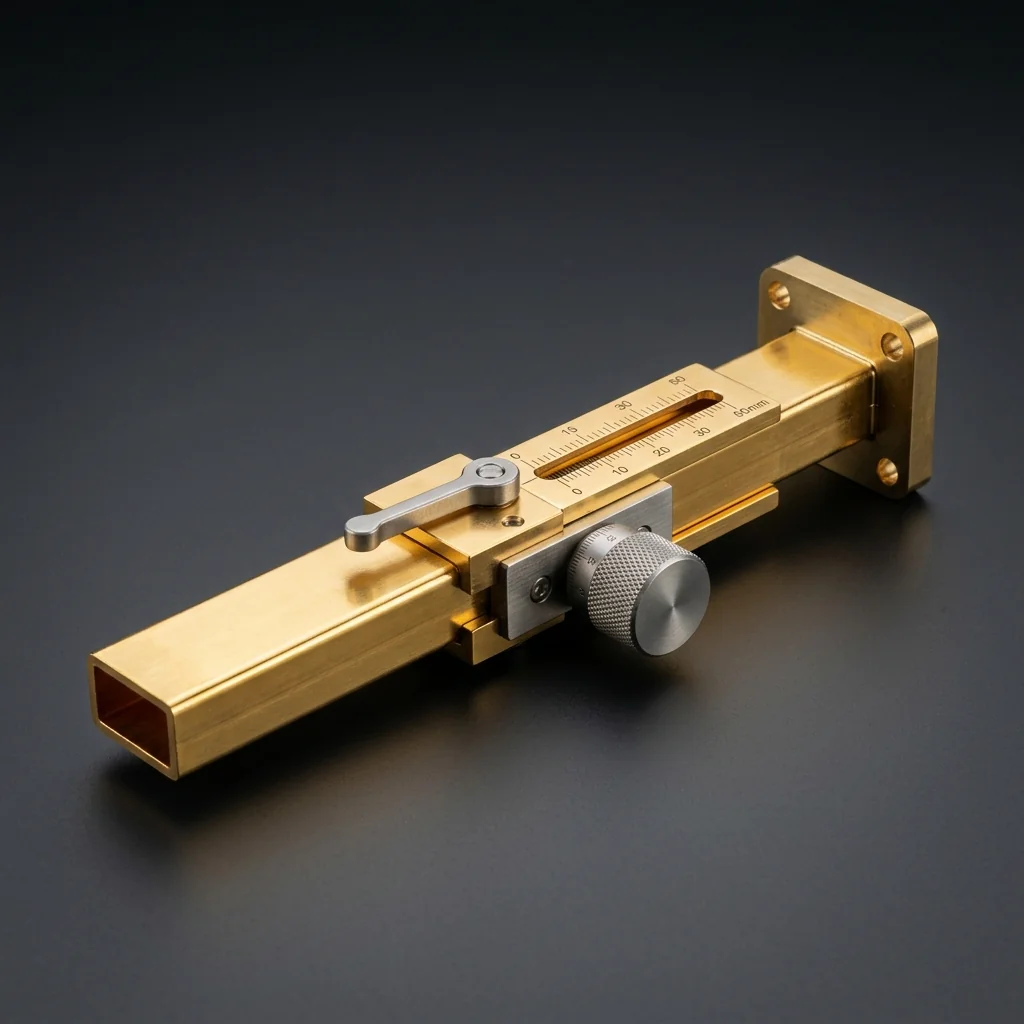
WR-22 Sliding Matched Termination
The WR-22 Sliding Matched Termination is a precision-engineered waveguide component that features an adjustable absorbing element for isolating and measuring residual reflections in test setups. It is specifically designed for the 33 - 50 GHz frequency range, serving as a critical building block in Q-Band infrastructure.
The absorbing wedge is attached to a micrometer. By physically sliding the wedge back and forth, the phase of the termination reflection changes, allowing engineers to mathematically cancel out system errors. WR-22 operates in the Q-Band (33-50 GHz), sitting right above the Ka-band. Its 0.224" x 0.112" aperture requires precise CNC machining, as surface roughness begins to significantly impact insertion loss at these frequencies.
Key Features
Adjustable Match
Sliding mechanism allows precise positioning of the absorptive element for optimized impedance matching at the target frequency.
Calibration Grade
Designed to calibration kit standards for use as a matched load reference in TRL and other calibration procedures.
Low Residual VSWR
When properly adjusted, achieves very low return loss for accurate reference plane establishment and measurement confidence.
Precision Mechanism
Smooth, low-friction sliding action with precision-machined internal bore for repeatable, accurate adjustments.
Q-Band Use Cases
Radio Astronomy
Molecular cloud mapping
Q-Band Satcom
Next-gen broadband links
Military Data
High-capacity secure comms
Test Equipment
Vector network analysis
More Sliding Matched Terminations
Frequently Asked Questions
Why does the termination need to slide?+
No termination is perfect. By sliding the load over at least one-half wavelength, you can observe the phase ripple of the imperfection on a VNA. You can then mathematically separate the reflection of the load from the reflection of the actual device under test.
What are the main applications for WR-22 Q-Band components?+
WR-22 is heavily utilized in advanced satellite communications (V-band/Q-band uplinks) to escape the congested Ka-band. It is also a critical band for radio astronomy, specifically for mapping complex molecules in deep space.
How does surface roughness affect WR-22?+
At 50 GHz, the skin depth of copper is incredibly thin (less than 0.3 micrometers). If the interior machining marks of the WR-22 component are larger than the skin depth, the RF current is forced to travel up and down the microscopic ridges, exponentially increasing resistive heating and insertion loss.