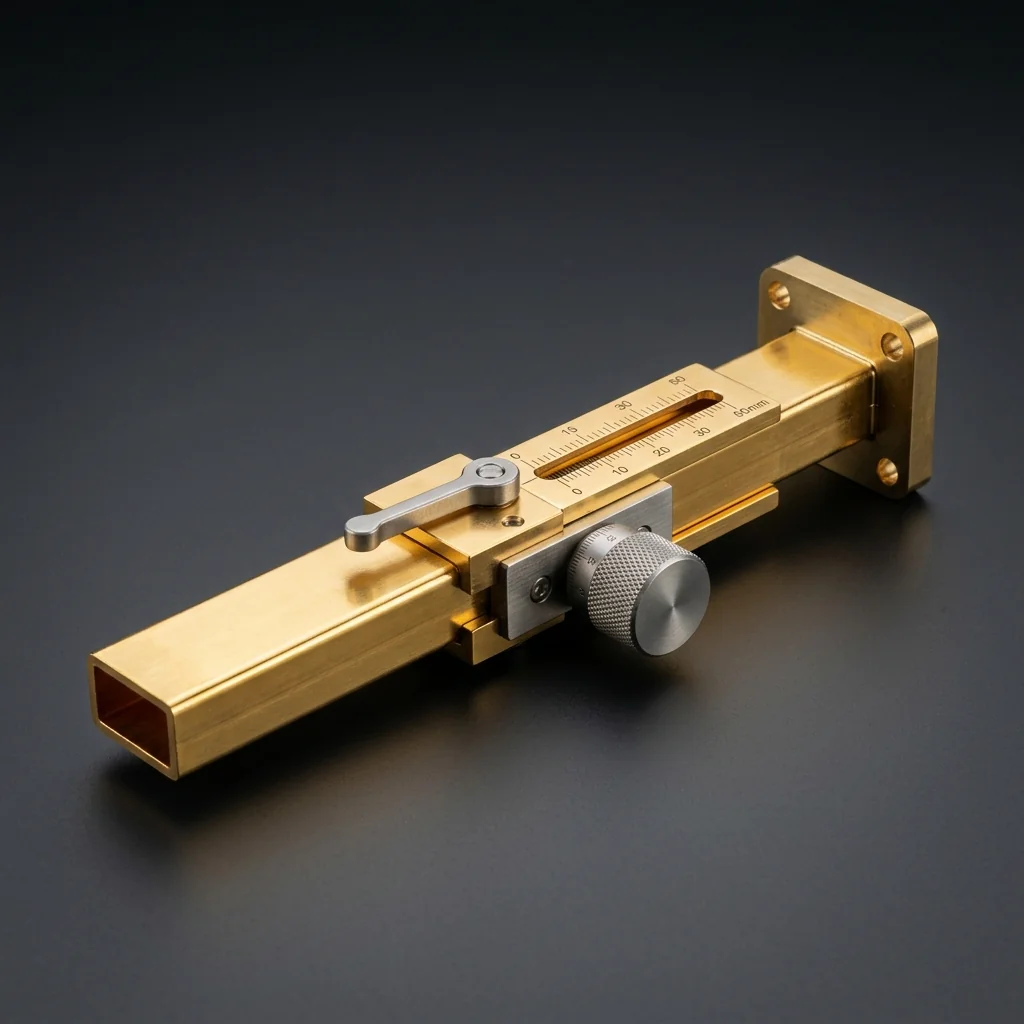
WR-10 Sliding Matched Termination
The WR-10 Sliding Matched Termination is a precision-engineered waveguide component that features an adjustable absorbing element for isolating and measuring residual reflections in test setups. It is specifically designed for the 75 - 110 GHz frequency range, serving as a critical building block in W-Band infrastructure.
The absorbing wedge is attached to a micrometer. By physically sliding the wedge back and forth, the phase of the termination reflection changes, allowing engineers to mathematically cancel out system errors. WR-10 encompasses the 75-110 GHz W-Band. It is heavily utilized for 77 GHz automotive radar systems (ADAS), requiring internal waveguide dimensions of precisely 0.100" x 0.050".
Key Features
Adjustable Match
Sliding mechanism allows precise positioning of the absorptive element for optimized impedance matching at the target frequency.
Calibration Grade
Designed to calibration kit standards for use as a matched load reference in TRL and other calibration procedures.
Low Residual VSWR
When properly adjusted, achieves very low return loss for accurate reference plane establishment and measurement confidence.
Precision Mechanism
Smooth, low-friction sliding action with precision-machined internal bore for repeatable, accurate adjustments.
W-Band Use Cases
Automotive Radar
77 GHz ADAS sensors
Passive Imaging
Security millimeter-wave
Defense Seeker
Missile terminal guidance
Materials Test
Dielectric characterization
More Sliding Matched Terminations
Frequently Asked Questions
Why does the termination need to slide?+
No termination is perfect. By sliding the load over at least one-half wavelength, you can observe the phase ripple of the imperfection on a VNA. You can then mathematically separate the reflection of the load from the reflection of the actual device under test.
Why is WR-10 the standard for automotive radar?+
The global standard for Advanced Driver Assistance Systems (ADAS) radar is 77 GHz to 81 GHz. WR-10 components (W-Band) are required for all test, measurement, and calibration systems used in the development and manufacturing of these automotive radar chips.
Can WR-10 handle high power?+
Because the aperture is only 0.100" x 0.050", the electric field density inside WR-10 is extreme even at moderate power levels. While it handles less total power than WR-28, a dry, nitrogen-purged WR-10 component can still safely pass over 100 Watts of CW power before experiencing dielectric breakdown.