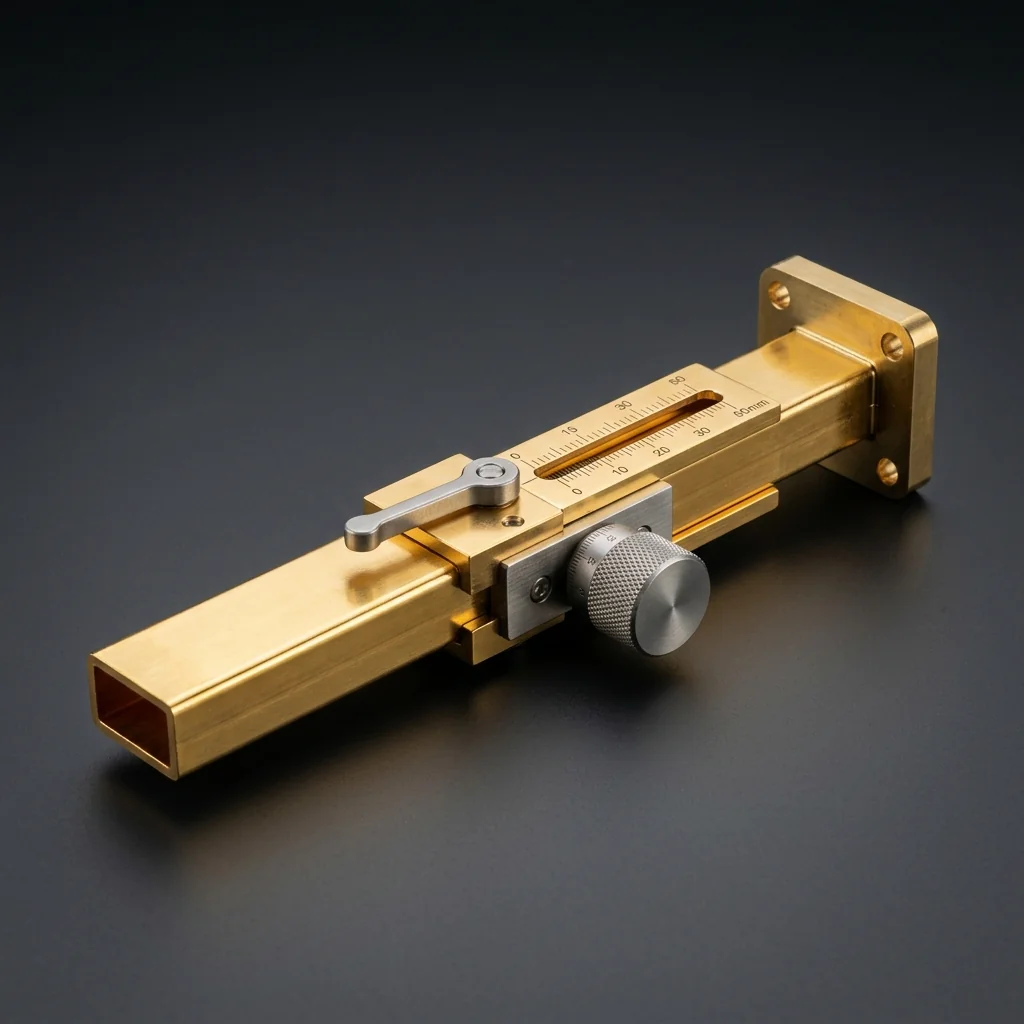
WR-19 Sliding Matched Termination
The WR-19 Sliding Matched Termination is a precision-engineered waveguide component that features an adjustable absorbing element for isolating and measuring residual reflections in test setups. It is specifically designed for the 40 - 60 GHz frequency range, serving as a critical building block in U-Band infrastructure.
The absorbing wedge is attached to a micrometer. By physically sliding the wedge back and forth, the phase of the termination reflection changes, allowing engineers to mathematically cancel out system errors. Covering the 40-60 GHz U-Band, WR-19 components operate near the 60 GHz atmospheric oxygen absorption spike. This makes WR-19 critical for secure, short-range military communications that cannot be intercepted from afar.
Key Features
Adjustable Match
Sliding mechanism allows precise positioning of the absorptive element for optimized impedance matching at the target frequency.
Calibration Grade
Designed to calibration kit standards for use as a matched load reference in TRL and other calibration procedures.
Low Residual VSWR
When properly adjusted, achieves very low return loss for accurate reference plane establishment and measurement confidence.
Precision Mechanism
Smooth, low-friction sliding action with precision-machined internal bore for repeatable, accurate adjustments.
U-Band Use Cases
V-Band WiGig
IEEE 802.11ad/ay testing
Covert Comms
Oxygen-absorption limits
Plasma Physics
High-frequency diagnostics
Radar Systems
Short-range tracking
More Sliding Matched Terminations
Frequently Asked Questions
Why does the termination need to slide?+
No termination is perfect. By sliding the load over at least one-half wavelength, you can observe the phase ripple of the imperfection on a VNA. You can then mathematically separate the reflection of the load from the reflection of the actual device under test.
Why is WR-19 used for secure communications?+
WR-19 covers frequencies approaching 60 GHz. At 60 GHz, oxygen molecules in the Earth's atmosphere naturally resonate and absorb the RF energy, severely limiting the transmission range. Military systems exploit this by creating secure point-to-point links that naturally dissipate before enemies can intercept them.
What flange types are standard for WR-19?+
Because the aperture is only 0.188" x 0.094", WR-19 typically utilizes UG-383/U or precision anti-cocking flanges to ensure perfect alignment. Even a 0.005" misalignment will cause massive VSWR spikes at 60 GHz.