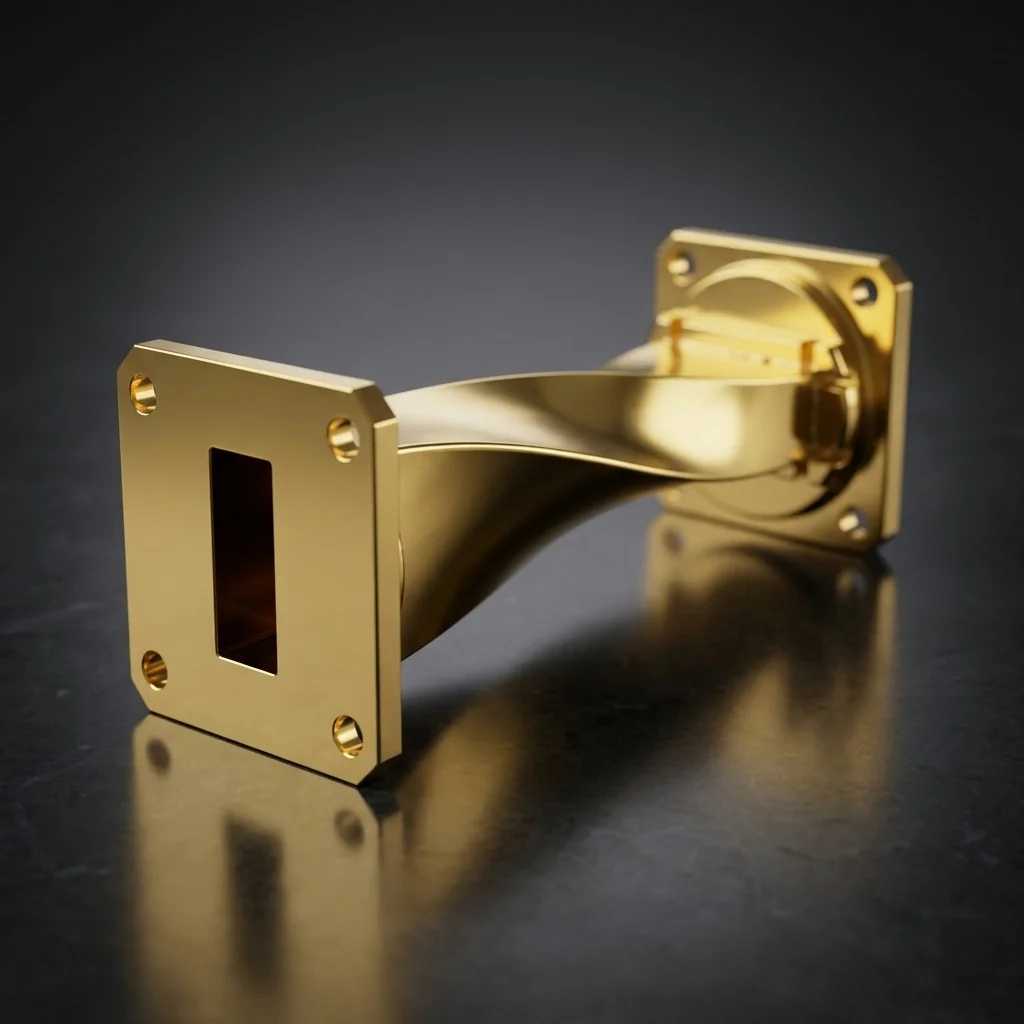
WR-28 Waveguide Twist
The WR-28 Waveguide Twist is a precision-engineered waveguide component that rotates the polarization of the electromagnetic wave by 90 degrees. It is specifically designed for the 26.5 - 40 GHz frequency range, serving as a critical building block in Ka-Band infrastructure.
The physical waveguide tube is gradually twisted along its longitudinal axis over a distance of at least two wavelengths, smoothly rotating the E-field and H-field without causing reflection. At Ka-Band frequencies (26.5-40 GHz), WR-28 components must balance high power handling with the onset of millimeter-wave skin depth challenges. The 0.280" x 0.140" aperture is the workhorse for modern 5G networks and LEO satellite constellations.
Key Features
Gradual Twist Profile
Progressive twist geometry minimizes signal reflections and maintains TE10 mode integrity through the full 90-degree rotation.
Low Insertion Loss
Precision-machined interior walls ensure consistent waveguide dimensions throughout the twist length for minimal signal degradation.
Compact Design
Optimized twist length balances compact form factor with RF performance, fitting into tight waveguide assemblies without compromising signal quality.
Gold-Plated Construction
OFHC copper body with gold plating provides excellent conductivity, corrosion resistance, and consistent long-term electrical performance.
Ka-Band Use Cases
5G NR Infrastructure
mmWave small cell routing
Satcom Terminals
Ka-band uplink/downlink
Airborne Radar
High-res targeting systems
Defense Comms
Secure point-to-point links
More Waveguide Twists
Frequently Asked Questions
Why twist the waveguide instead of just rotating the flange?+
Many complex systems (like satellite feed horns or radar gimbals) require the signal to exit at a 90-degree angle to the transmitter. Since you cannot simply bolt two rectangular flanges together at 90 degrees without completely blocking the wave, a dedicated twist component must be used.
Why is WR-28 the standard for early mmWave 5G?+
WR-28 covers the critical 28 GHz and 39 GHz 5G NR frequency bands (n257, n258, n260, n261). Its physical size allows for high power handling at base stations while maintaining low insertion loss before the signal is distributed to the phased array antenna elements.
What is the theoretical cut-off frequency for WR-28?+
The dominant TE10 mode cut-off frequency for a standard WR-28 waveguide is approximately 21.08 GHz. This guarantees single-mode propagation throughout the entire Ka-Band.