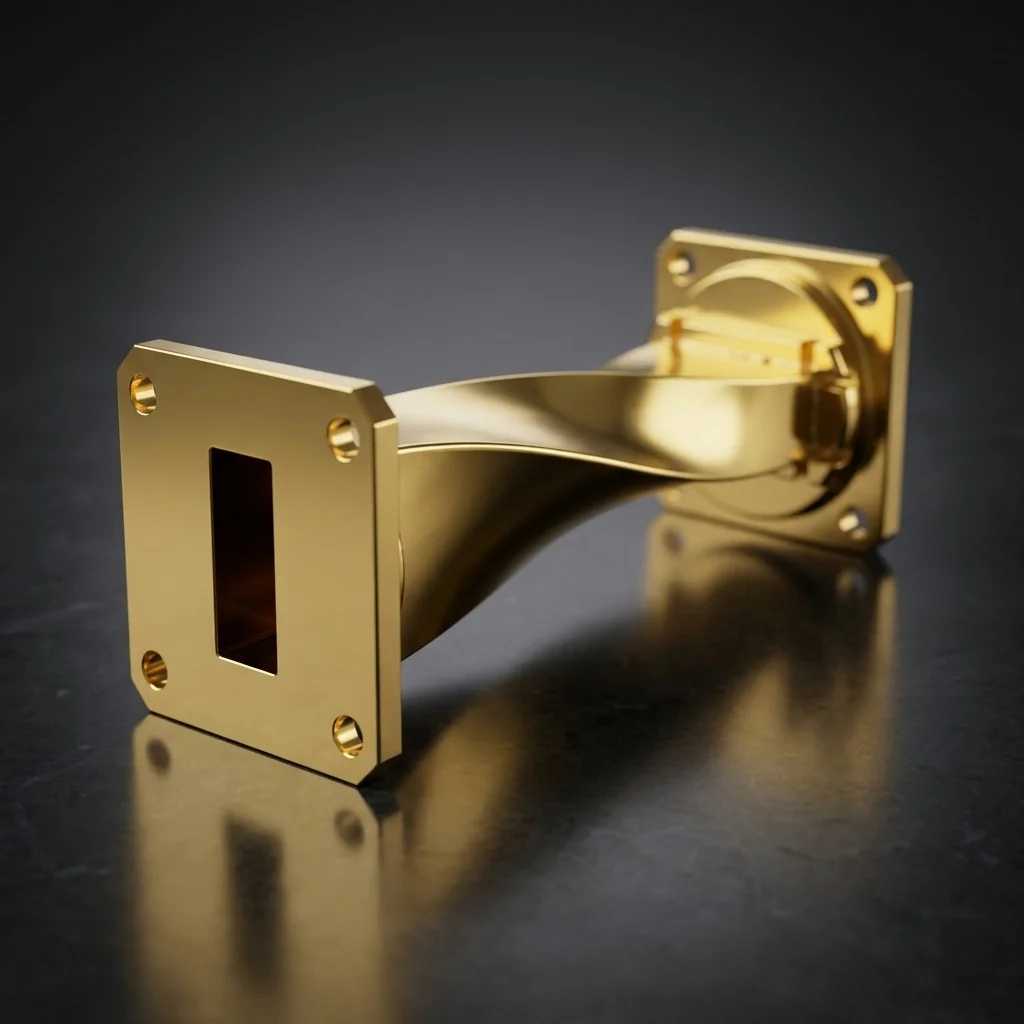
WR-10 Waveguide Twist
The WR-10 Waveguide Twist is a precision-engineered waveguide component that rotates the polarization of the electromagnetic wave by 90 degrees. It is specifically designed for the 75 - 110 GHz frequency range, serving as a critical building block in W-Band infrastructure.
The physical waveguide tube is gradually twisted along its longitudinal axis over a distance of at least two wavelengths, smoothly rotating the E-field and H-field without causing reflection. WR-10 encompasses the 75-110 GHz W-Band. It is heavily utilized for 77 GHz automotive radar systems (ADAS), requiring internal waveguide dimensions of precisely 0.100" x 0.050".
Key Features
Gradual Twist Profile
Progressive twist geometry minimizes signal reflections and maintains TE10 mode integrity through the full 90-degree rotation.
Low Insertion Loss
Precision-machined interior walls ensure consistent waveguide dimensions throughout the twist length for minimal signal degradation.
Compact Design
Optimized twist length balances compact form factor with RF performance, fitting into tight waveguide assemblies without compromising signal quality.
Gold-Plated Construction
OFHC copper body with gold plating provides excellent conductivity, corrosion resistance, and consistent long-term electrical performance.
W-Band Use Cases
Automotive Radar
77 GHz ADAS sensors
Passive Imaging
Security millimeter-wave
Defense Seeker
Missile terminal guidance
Materials Test
Dielectric characterization
More Waveguide Twists
Frequently Asked Questions
Why twist the waveguide instead of just rotating the flange?+
Many complex systems (like satellite feed horns or radar gimbals) require the signal to exit at a 90-degree angle to the transmitter. Since you cannot simply bolt two rectangular flanges together at 90 degrees without completely blocking the wave, a dedicated twist component must be used.
Why is WR-10 the standard for automotive radar?+
The global standard for Advanced Driver Assistance Systems (ADAS) radar is 77 GHz to 81 GHz. WR-10 components (W-Band) are required for all test, measurement, and calibration systems used in the development and manufacturing of these automotive radar chips.
Can WR-10 handle high power?+
Because the aperture is only 0.100" x 0.050", the electric field density inside WR-10 is extreme even at moderate power levels. While it handles less total power than WR-28, a dry, nitrogen-purged WR-10 component can still safely pass over 100 Watts of CW power before experiencing dielectric breakdown.