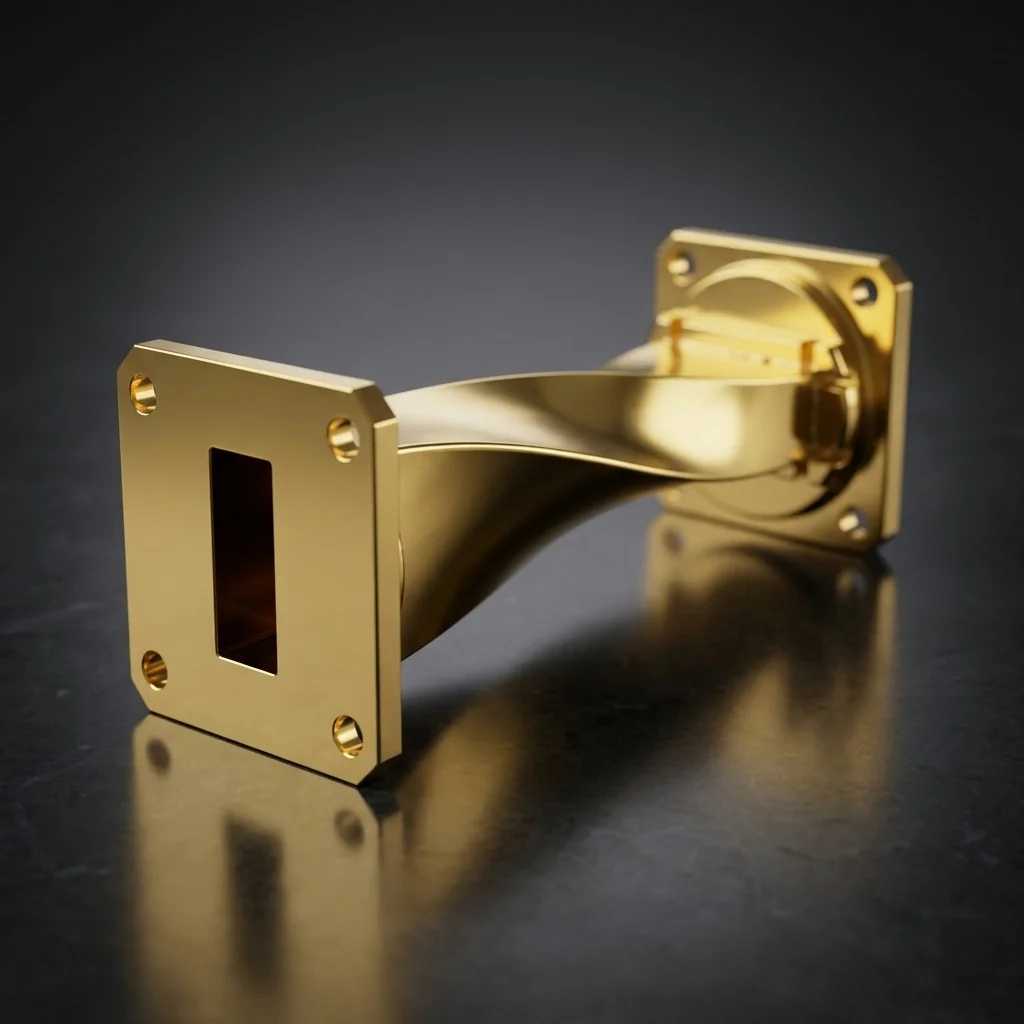
WR-19 Waveguide Twist
The WR-19 Waveguide Twist is a precision-engineered waveguide component that rotates the polarization of the electromagnetic wave by 90 degrees. It is specifically designed for the 40 - 60 GHz frequency range, serving as a critical building block in U-Band infrastructure.
The physical waveguide tube is gradually twisted along its longitudinal axis over a distance of at least two wavelengths, smoothly rotating the E-field and H-field without causing reflection. Covering the 40-60 GHz U-Band, WR-19 components operate near the 60 GHz atmospheric oxygen absorption spike. This makes WR-19 critical for secure, short-range military communications that cannot be intercepted from afar.
Key Features
Gradual Twist Profile
Progressive twist geometry minimizes signal reflections and maintains TE10 mode integrity through the full 90-degree rotation.
Low Insertion Loss
Precision-machined interior walls ensure consistent waveguide dimensions throughout the twist length for minimal signal degradation.
Compact Design
Optimized twist length balances compact form factor with RF performance, fitting into tight waveguide assemblies without compromising signal quality.
Gold-Plated Construction
OFHC copper body with gold plating provides excellent conductivity, corrosion resistance, and consistent long-term electrical performance.
U-Band Use Cases
V-Band WiGig
IEEE 802.11ad/ay testing
Covert Comms
Oxygen-absorption limits
Plasma Physics
High-frequency diagnostics
Radar Systems
Short-range tracking
More Waveguide Twists
Frequently Asked Questions
Why twist the waveguide instead of just rotating the flange?+
Many complex systems (like satellite feed horns or radar gimbals) require the signal to exit at a 90-degree angle to the transmitter. Since you cannot simply bolt two rectangular flanges together at 90 degrees without completely blocking the wave, a dedicated twist component must be used.
Why is WR-19 used for secure communications?+
WR-19 covers frequencies approaching 60 GHz. At 60 GHz, oxygen molecules in the Earth's atmosphere naturally resonate and absorb the RF energy, severely limiting the transmission range. Military systems exploit this by creating secure point-to-point links that naturally dissipate before enemies can intercept them.
What flange types are standard for WR-19?+
Because the aperture is only 0.188" x 0.094", WR-19 typically utilizes UG-383/U or precision anti-cocking flanges to ensure perfect alignment. Even a 0.005" misalignment will cause massive VSWR spikes at 60 GHz.