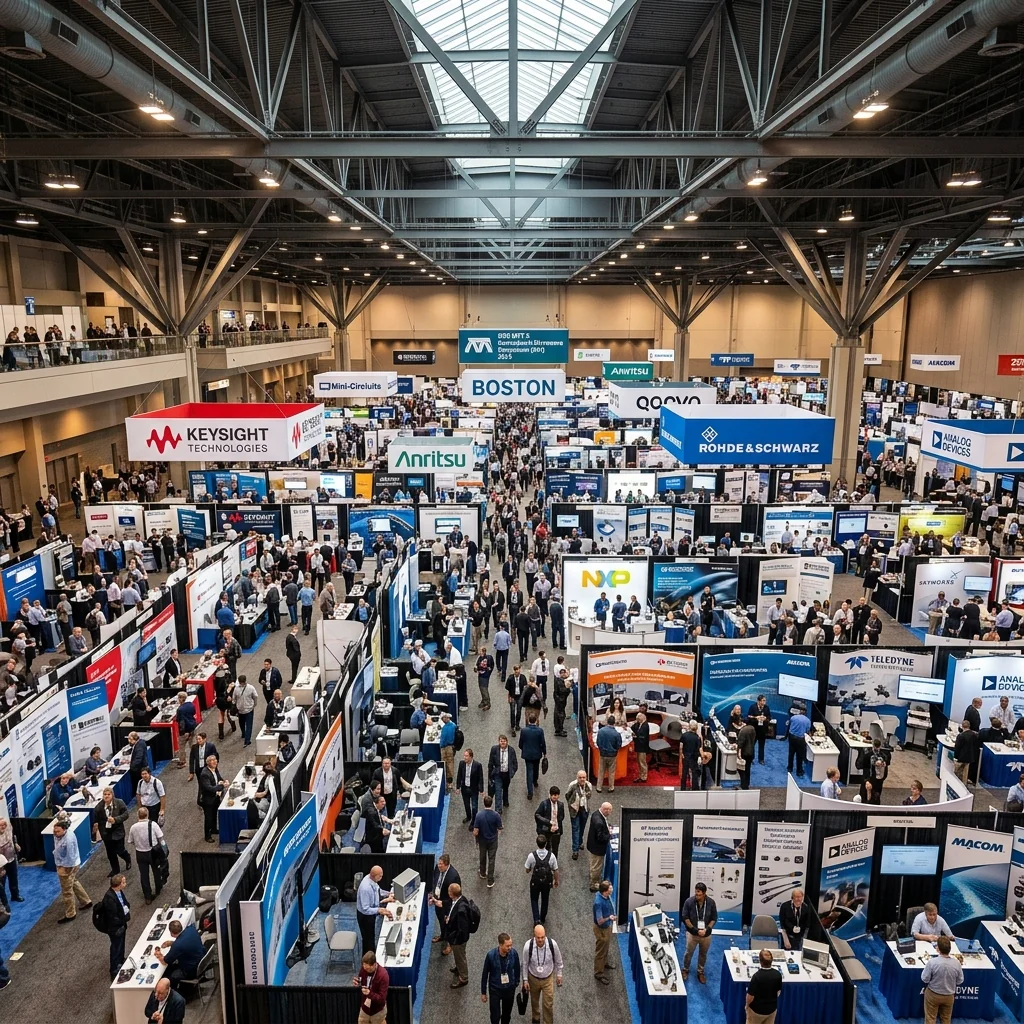
On November 7, 1952, 210 engineers gathered at the Western Union Auditorium in New York City to hear 10 papers on microwave theory and techniques. That meeting, organized by the IRE Professional Group on Microwave Theory and Techniques (the predecessor to IEEE MTT-S), was the first International Microwave Symposium. Seventy-four years later, IMS has grown into the largest annual gathering of RF, microwave, millimeter-wave, and terahertz professionals in the world. In 2026, it returns to Boston, and the week of June 7 through 12 will bring over 10,000 attendees, 500+ exhibitors, and hundreds of peer-reviewed papers to the Thomas M. Menino Convention and Exhibition Center.
A Brief History of IMS
The symposium has run every year since 1952, with the sole exception of 1955. What started as a domestic technical meeting evolved into a truly international event by the mid-1960s. The name "International Microwave Symposium" was formally adopted in 1966 for the Palo Alto edition. Through the decades, IMS has tracked the technology waves of the microwave industry: the magnetron era of the 1950s, the solid-state revolution of the 1970s, the MMIC explosion of the 1980s, the wireless telecom build-out of the 1990s and 2000s, and the current push into mmWave 5G, phased arrays, and terahertz systems.
The exhibition floor has grown to match. In the 1980s, a few dozen companies displayed oscillators, test equipment, and waveguide hardware. Today, the expo occupies hundreds of thousands of square feet and includes everyone from Rohde & Schwarz and Keysight on the test and measurement side, to Analog Devices and Qorvo on the semiconductor side, to precision component houses like Flann Microwave, Aerowave, and RF Essentials. The show floor is where data sheets come to life. You can hold a WR-10 waveguide transition, probe a GaN MMIC under a microscope, or sit down with an FAE who actually designed the part you have been specifying from a PDF.
What is Different About IMS 2026
This year, IEEE MTT-S has restructured the technical program into three distinct symposia that run in parallel:
| Symposium | Focus | What to Expect |
|---|---|---|
| RFIC | RF Integrated Circuits | SiGe, CMOS, GaN, and InP MMIC design papers. Process nodes, noise figure records, power density benchmarks. |
| RFTT | RF Technology & Techniques (new) | Passive components, packaging, thermal management, advanced manufacturing. The hardware track. |
| RFSA | RF Systems & Applications (new) | Radar, SATCOM, 5G/6G systems, biomedical RF, IoT, quantum. The systems-level track. |
The split is meaningful. Previous IMS editions grouped everything under one umbrella, which meant a phased array systems paper competed for session time with a low-noise CMOS LNA paper. Separating the tracks gives each discipline more room. RFTT, the new Technology and Techniques track, is particularly relevant for engineers who work with waveguide components, passive networks, and advanced packaging, the areas where mechanical precision meets electromagnetic performance.
The ARFTG Microwave Measurement Conference also runs during the week, along with the IEEE Hard Tech Venture Summit, a new co-located event connecting early-stage RF hardware startups with investors and strategic partners. That summit reflects something real: after years of software eating the world, capital is flowing back into physical-layer technology. Companies building GaN foundry capacity, phased array modules, and quantum-enabling microwave hardware are attracting funding at levels not seen since the early 2000s telecom build-out.
The Technologies Defining the Exhibition Floor in 2026
GaN Is No Longer Emerging
Gallium nitride power amplifiers have moved from exotic to expected. At IMS 2024 and 2025, GaN dominated the power amplifier sessions. In 2026, the conversation has shifted from "can GaN replace GaAs and LDMOS" to "which GaN process node for which application." GaN-on-SiC remains the performance leader for defense phased arrays and SATCOM, delivering 8 to 10 W/mm of gate periphery at frequencies through Ka-band. GaN-on-Si, cheaper to produce at volume, is gaining ground in 5G macro base station PAs and commercial radar modules. Qorvo, Wolfspeed, MACOM, and Analog Devices will all be demonstrating production GaN devices at IMS 2026. The practical questions for engineers visiting the show: what is the reliability data at junction temperatures above 200°C, what foundry capacity is available for custom designs, and which process supports operation above 40 GHz.
Phased Arrays Go Mainstream
Phased array antenna systems, once confined to military radar and satellite ground terminals, are now shipping in commercial 5G base stations, LEO satellite user terminals (Starlink, OneWeb, Amazon Kuiper), and automotive radar modules. IMS 2026 will feature dozens of papers and exhibitors addressing the full phased array supply chain: beamforming ICs, antenna element design, calibration algorithms, and thermal management solutions for arrays dissipating 100+ watts in compact enclosures. The integration challenge is where the industry is spending most of its engineering effort. A 256-element Ka-band phased array contains thousands of individual components (amplifiers, phase shifters, power dividers, antenna elements) that must work together with phase coherence better than 5° RMS across the aperture. Achieving that in a manufacturable, reliable, cost-effective package is the defining engineering problem of the current era.
Sub-THz and 6G Research
Papers on D-band (110 to 170 GHz) and beyond are no longer speculative. Multiple research groups will present working transceivers at 140 GHz, 220 GHz, and 300 GHz, with data rates exceeding 100 Gbps over short links. The 6G community has largely coalesced around the 140 GHz band as the leading candidate for next-generation high-capacity wireless, and IMS 2026 will showcase the component-level building blocks required to make that vision real: InP HBT amplifiers with gain above 10 dB at 200 GHz, silicon-germanium transceivers for low-cost D-band systems, and waveguide-to-chip transitions that maintain performance at frequencies where a WR-6 waveguide aperture is just 1.651 mm wide.
AI-Driven RF Design
Machine learning has entered the RF design workflow. At IMS 2025, several papers demonstrated neural network-based optimization of matching networks, filter topologies, and antenna geometries that outperformed traditional gradient-descent methods in convergence speed. At IMS 2026, expect to see AI tools from EDA vendors (Cadence AWR, Keysight ADS, Ansys HFSS) integrated directly into commercial simulation platforms. The practical applications are compelling: an AI optimizer that explores 10,000 matching network topologies in the time a human engineer evaluates 50, or a surrogate model that predicts the S-parameters of a complex waveguide structure in milliseconds instead of the hours required by a full-wave simulation. The tools do not replace engineering judgment. They accelerate the iteration cycle.
Advanced Packaging and Heterogeneous Integration
The performance ceiling for monolithic MMICs is real. A single process technology cannot simultaneously optimize the low-noise front end (InP or SiGe), the power amplifier (GaN), the digital control logic (CMOS), and the antenna interface (organic or LTCC substrate). Heterogeneous integration, combining multiple die from different process technologies into a single package, is the path forward. IMS 2026 will feature papers on chiplet-based mmWave modules, interposer architectures for multi-die RF assemblies, and advanced fan-out wafer-level packaging that places GaN PA die within 200 μm of SiGe beamformer die on a shared substrate. The manufacturing infrastructure for these approaches is still maturing, and the show floor will reveal which packaging houses and foundries are production-ready versus still in the R&D phase.
The Exhibition Floor Is the Product: IMS papers present the theory. The exhibition floor presents the hardware you can buy. For engineers who specify and purchase RF components, the expo is where you evaluate surface finish on a waveguide flange, measure the weight of a phased array module in your hand, and compare the actual test data that never makes it into the data sheet. There is no substitute for standing at a booth and asking the engineer who designed the part why they made the choices they made.
Why IMS Still Matters in the Age of Remote Work
The microwave industry is small. There are perhaps 50,000 to 100,000 engineers worldwide who work primarily with RF, microwave, and mmWave technology. Many of them work at the same 200 companies, read the same journals, and attend the same conference. IMS is the week when the entire supply chain occupies the same building: the foundry that grows your GaN epitaxy, the MMIC design house that lays out your beamformer, the PCB shop that fabricates your mmWave substrate, the test equipment vendor whose VNA you use every day, and the waveguide component supplier who machines your WR-10 transitions to ±5 μm tolerance.
The conversations that happen in the aisles between booths, over coffee in the convention center lobby, and at the evening receptions produce more business outcomes than the formal technical sessions. Partnerships form. Supply chain problems get solved face-to-face in 15 minutes that would have taken three months of email. A component engineer discovers a new vendor whose catalog solves a problem that has been blocking a design review. A startup founder meets an investor who understands the physics well enough to write the check.
Remote work has changed how RF engineers do their daily jobs, but it has not changed the fact that precision hardware requires physical evaluation, and business relationships require human presence. IMS is the annual proof of that principle.
Planning Your Week in Boston
The full Microwave Week runs Sunday June 7 through Friday June 12. Workshops and short courses fill the first two days (Sunday and Monday), with the main technical sessions and exhibition running Tuesday through Thursday. The ARFTG measurement conference typically occupies Friday. For engineers with limited travel budgets, Tuesday through Thursday covers the exhibition and the highest-density technical sessions. For engineers who want the full experience, the Sunday and Monday workshops provide deep-dive tutorials on specific topics, typically four to eight hours on subjects like GaN reliability, phased array calibration, or mmWave packaging.
- Sunday – Monday, June 7-8: Workshops, short courses, and tutorials. Pre-registration required for most sessions.
- Tuesday – Thursday, June 9-11: Main technical program (RFIC, RFTT, RFSA), exhibition floor open, panel discussions, industry sessions, Hard Tech Venture Summit.
- Thursday evening: IMS closing reception. Historically the best single networking event of the week.
- Friday, June 12: ARFTG Microwave Measurement Conference.
Boston in June is comfortable: expect daytime temperatures around 70 to 80°F. The Menino Convention Center (also known as the Boston Convention and Exhibition Center, or BCEC) sits in the Seaport District, within walking distance of hotels, restaurants, and the waterfront. The venue is well-suited for IMS: a single level exhibition hall that keeps all 500+ booths visible without the multi-floor navigation that plagued some previous IMS locations.
RF Essentials at IMS 2026
I attend IMS every year. It is the one week where I can sit down face-to-face with the engineers and procurement teams who rely on our waveguide hardware, and with the suppliers and partners whose work feeds directly into what we build. There is no better environment for understanding where the industry is heading and what our customers need next.
This year, I am particularly looking forward to conversations around D-band waveguide requirements, advanced flange standards for systems above 110 GHz, and the thermal challenges that come with integrating GaN amplifiers into compact phased array modules. These are the problems our customers are bringing to us right now, and IMS is where we align on solutions. If you are working through a design challenge that involves precision waveguide assemblies, custom transitions, or mmWave test accessories, I want to hear about it. Bring your drawings. Bring your problem. We have spent the last year expanding our machining capabilities and our catalog, and the show floor is where I can demonstrate what that means in practice.
If you want to connect during Microwave Week, reach out ahead of time so we can schedule a meeting. The exhibition days fill up fast, and pre-scheduled conversations are always more productive than trying to catch someone between booths. I am genuinely looking forward to reconnecting with longtime partners and meeting new ones. That is what IMS is about for me: aligning goals, solving problems together, and building relationships that last well beyond the convention floor.
We will be covering IMS 2026 throughout the week with updates on new product announcements, notable papers, and technology trends. Follow along on our Industry News section.
Schedule a meeting with RF Essentials during Microwave Week in Boston, June 7-12. Waveguide components, custom assemblies, and mmWave hardware.
Gary Ricker founded RF Essentials to fill a gap in the precision millimeter wave component supply chain. With over 20 years of experience in RF engineering and manufacturing, he oversees product development, customer relationships, and the company's technical direction. He attends IMS annually and is available for meetings during Microwave Week.