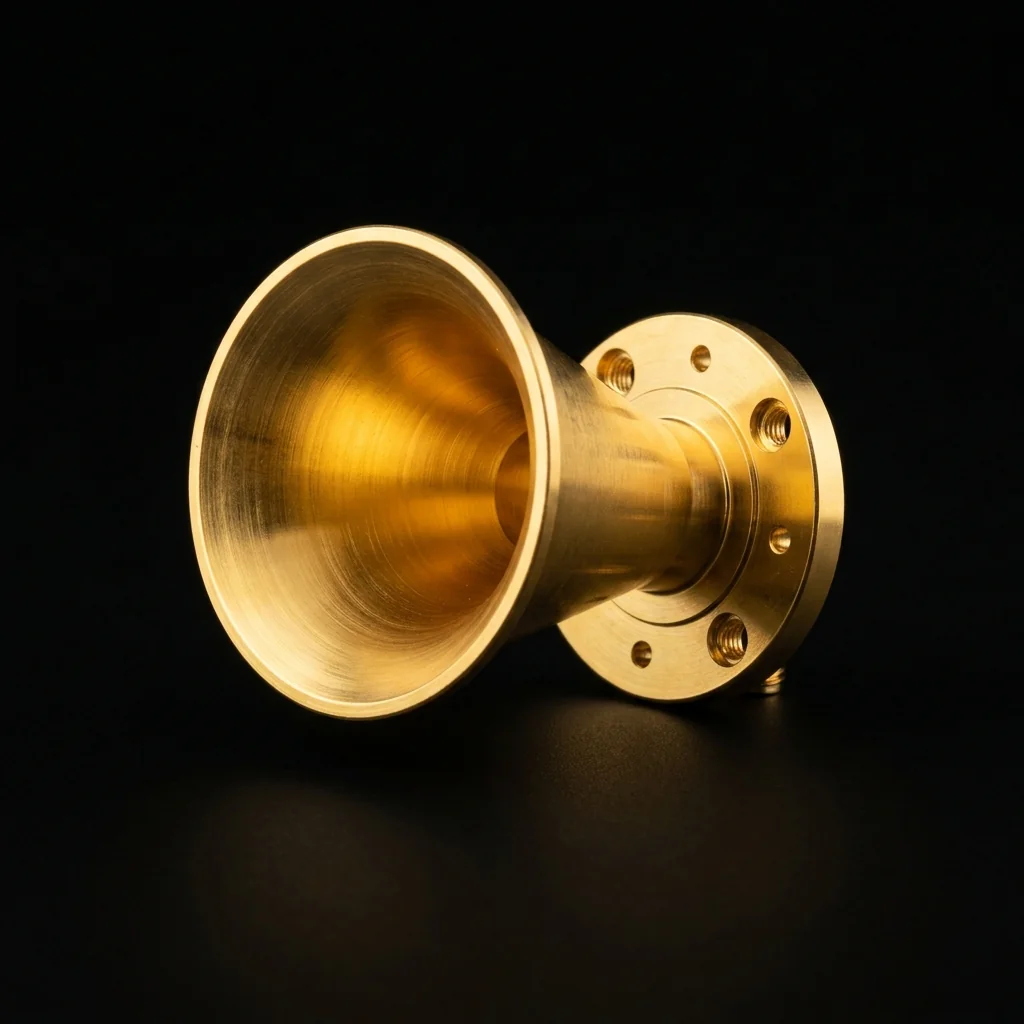
Conical Horn
Antennas
Circular waveguide horn antennas with rotationally symmetric radiation patterns, broadband impedance matching, and stable gain from 8.2 GHz to 325 GHz. Ideal for reflector feeds, measurement systems, radar, and communications.
Symmetrical Patterns from a Circular Aperture
RF Essentials conical horn antennas use a circular waveguide with a gradually expanding conical flare to transition electromagnetic energy into free space. The rotationally symmetric geometry produces uniform E-plane and H-plane radiation patterns, making them superior to pyramidal horns for applications where pattern symmetry is critical.
Available across 13 standard waveguide bands from X-band through J-band, these antennas deliver broadband impedance matching, low VSWR, and consistent gain. Their smooth beam characteristics make them the preferred choice for reflector antenna feed systems, antenna measurement ranges, and broadband communications platforms.
Conical Horn Antennas by Waveguide Band
Each row represents a standard conical horn configuration. Gain values are typical at mid-band. Multiple aperture sizes and gain levels are available per band. Custom frequency sub-bands, polarization, and mechanical configurations on request.
13 Waveguide Bands| WR Band | Waveguide Band | Frequency Range | Typical Gain | Polarization | Flange |
|---|---|---|---|---|---|
| WR-90 | X-Band | 8.2 - 12.4 GHz | 10 - 22 dBi | Linear | UG-135/U |
| WR-62 | Ku-Band | 12.4 - 18.0 GHz | 10 - 22 dBi | Linear | UG-419/U |
| WR-42 | K-Band | 18.0 - 26.5 GHz | 10 - 24 dBi | Linear | UG-595/U |
| WR-28 | Ka-Band | 26.5 - 40.0 GHz | 10 - 24 dBi | Linear | UG-599/U |
| WR-22 | Q-Band | 33.0 - 50.0 GHz | 10 - 24 dBi | Linear | UG-383/U |
| WR-19 | U-Band | 40.0 - 60.0 GHz | 10 - 24 dBi | Linear | UG-383/U-M |
| WR-15 | V-Band | 50.0 - 75.0 GHz | 10 - 24 dBi | Linear | UG-385/U |
| WR-12 | E-Band | 60.0 - 90.0 GHz | 10 - 24 dBi | Linear | UG-387/U |
| WR-10 | W-Band | 75.0 - 110.0 GHz | 10 - 24 dBi | Linear | UG-387/U-M |
| WR-8 | F-Band | 90.0 - 140.0 GHz | 10 - 22 dBi | Linear | UG-387/U-M |
| WR-6 | D-Band | 110.0 - 170.0 GHz | 10 - 22 dBi | Linear | UG-387/U-M |
| WR-5 | G-Band | 140.0 - 220.0 GHz | 10 - 22 dBi | Linear | UG-387/U-M |
| WR-3 | J-Band | 220.0 - 325.0 GHz | 10 - 20 dBi | Linear | UG-387/U-M |
All specifications are typical at representative mid-band frequencies. Multiple aperture sizes available per band. Contact engineering for detailed patterns, datasheets, and custom configurations.
Need a specific band or aperture configuration?
Our engineering team can provide pricing, datasheets, custom gain levels, and mechanical integration support for any conical horn configuration in the catalog.
Design & Construction
Circular cross-section waveguide with a gradually expanding conical flare. This geometry produces rotationally symmetric radiation patterns with uniform E-plane and H-plane beam characteristics.
The conical flare provides smooth impedance transition from waveguide to free space across the full operating bandwidth. Low VSWR and minimal reflections across the entire band without tuning.
Consistent gain performance across the full waveguide band with controlled beamwidth and predictable directivity. Gain levels from 10 to 24 dBi depending on aperture diameter.
Rotationally symmetric beam shapes make conical horns the preferred feed for reflector antennas and ideal for applications requiring uniform spatial coverage and consistent cross-polarization performance.
Split-block machined housing with tight dimensional tolerances. Gold or silver plating on RF surfaces for minimum insertion loss. Critical at millimeter-wave and submillimeter frequencies.
Custom aperture diameters, gain targets, polarization (linear/circular), flange interfaces, and mechanical mounting. Dual-polarized and corrugated variants available for specialized feed applications.
Where Conical Horns Perform
RF Essentials conical horn antennas are deployed where symmetrical radiation patterns, broadband impedance matching, and stable gain are required. Their circular aperture geometry makes them the natural choice for reflector feed systems and measurement environments.
- Reflector Antenna Feed Systems
- Antenna Measurement Ranges
- Broadband Communications Links
- Radar Calibration & Testing
- EMC / Radiated Emissions Testing
- 5G / 6G mmWave Research
- Signal Propagation Studies
- Defense & Surveillance Systems

Other Antenna Categories
Standard Gain Horns
Pyramidal horn antennas with rectangular waveguide interfaces for calibration, gain measurement, and reference applications.
View CategoryHorn Lens Antennas
Dielectric lens-corrected horn antennas for high-gain, narrow beamwidth applications across mmWave frequencies.
View CategoryFrequently Asked Questions
A conical horn antenna uses a circular waveguide with a gradually expanding conical flare to transition electromagnetic energy into free space. The rotationally symmetric geometry produces uniform radiation patterns in both E-plane and H-plane, with broadband impedance matching and stable gain across the full waveguide band.
Pyramidal (standard gain) horns use rectangular waveguide and produce asymmetric E-plane and H-plane patterns. Conical horns use circular waveguide and produce rotationally symmetric patterns. This makes conical horns preferred for reflector antenna feeds, applications requiring pattern symmetry, and systems where uniform spatial coverage is critical.
RF Essentials offers conical horn antennas across 13 standard waveguide bands from WR-90 (8.2 GHz, X-band) through WR-3 (325 GHz, J-band). Multiple aperture sizes and gain levels are available per band, with custom sub-band configurations on request.
Common applications include reflector antenna feed systems, antenna measurement ranges, radar calibration, broadband communications links, EMC testing, and RF research. Their symmetrical patterns and broadband performance make them versatile across both test and operational environments.