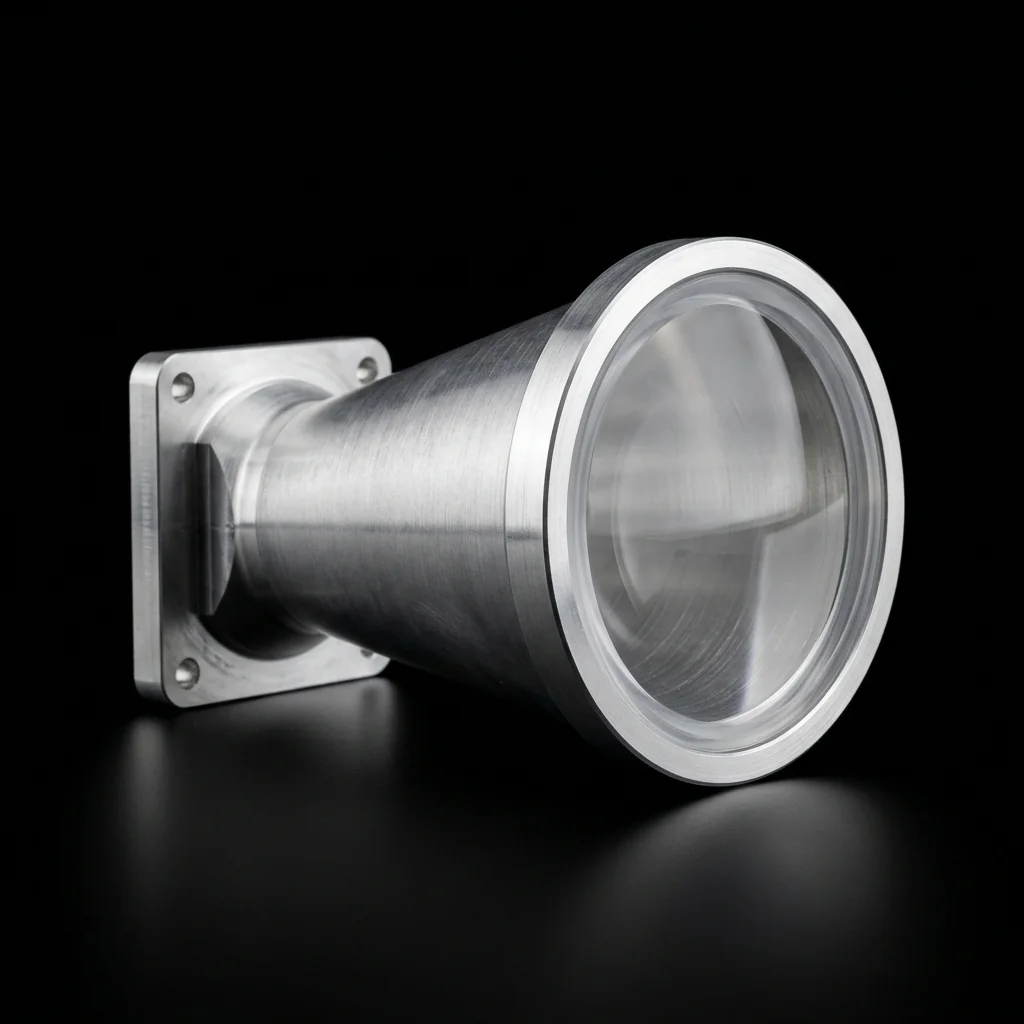
Horn Lens
Antennas
Lens-corrected horn antennas combining waveguide-fed horn radiators with precision dielectric lenses. Enhanced directivity, low sidelobes, and symmetrical beam patterns from 8.2 GHz to 170 GHz for measurement, radar, and communications.
Lens-Corrected Horns for Precision Beam Control
RF Essentials horn lens antennas pair a waveguide-fed horn radiator with a precision dielectric lens mounted at the aperture. The lens corrects the curved phase front produced by the horn into a planar wavefront, dramatically improving gain, narrowing beamwidth, and suppressing sidelobe levels compared to uncorrected horns.
This hybrid design delivers the broadband impedance matching of a horn antenna with the focused beam characteristics typically associated with reflector systems. Available in 3, 6, 9, and 12 inch apertures across 11 waveguide bands from X-band through D-band. Ideal for antenna measurement ranges, radar testing, and high-frequency communications where beam quality and pattern repeatability are critical.
Horn Lens Antennas by Waveguide Band
Each row represents a standard waveguide band where RF Essentials offers horn lens antennas. Available in 3", 6", 9", and 12" aperture diameters per band. Gain values are typical at mid-band for the 6" aperture. Custom apertures, lens profiles, and frequency ranges available on request.
11 Waveguide Bands| WR Band | Waveguide Band | Frequency Range | Typical Gain (6") | Apertures | Polarization | Flange |
|---|---|---|---|---|---|---|
| WR-90 | X-Band | 8.2 – 12.4 GHz | 28 dBi | 12" | Linear | UG-39/U |
| WR-62 | Ku-Band | 12.4 – 18.0 GHz | 32 dBi | 9", 12" | Linear | UG-419/U |
| WR-42 | K-Band | 18.0 – 26.5 GHz | 35 dBi | 6", 9", 12" | Linear | UG-595/U |
| WR-28 | Ka-Band | 26.5 – 40.0 GHz | 38 dBi | 6", 9", 12" | Linear | UG-599/U |
| WR-22 | Q-Band | 33.0 – 50.0 GHz | 40 dBi | 3", 6", 9", 12" | Linear | UG-383/U |
| WR-19 | U-Band | 38.5 – 60.0 GHz | 41 dBi | 3", 6", 9", 12" | Linear | UG-383/U-M |
| WR-15 | V-Band | 50.0 – 75.0 GHz | 42 dBi | 3", 6", 9", 12" | Linear | UG-385/U |
| WR-12 | E-Band | 60.0 – 90.0 GHz | 43 dBi | 3", 6", 9", 12" | Linear | UG-387/U |
| WR-10 | W-Band | 75.0 – 110.0 GHz | 44 dBi | 3", 6", 9", 12" | Linear | UG-387/U |
| WR-8 | F-Band | 90.0 – 140.0 GHz | 45 dBi | 3", 6", 9", 12" | Linear | UG-387/U-M |
| WR-6 | D-Band | 110.0 – 170.0 GHz | 46 dBi | 3", 6", 9", 12" | Linear | UG-387/U |
Gain values shown are typical for 6" aperture at mid-band. Larger apertures produce higher gain. Contact engineering for detailed patterns and datasheets.
Design & Construction
Precision-machined HDPE or Rexolite lens converts the horn's curved phase front into a planar wavefront. Delivers higher gain and tighter beam control from the same aperture size as an uncorrected horn.
Lens phase correction suppresses sidelobe levels well below those of standard gain horns. Critical for antenna ranges, RCS measurement, and environments where off-axis radiation must be minimized.
Horn-lens combination maintains consistent gain and pattern performance across the full waveguide band. No tuning required when operating at any frequency within the specified range.
Circular waveguide feed produces symmetrical E-plane and H-plane patterns with low cross-polarization. Essential for dual-polarized systems and precision antenna measurements.
CNC-machined horn bodies with gold-plated internal surfaces for minimum insertion loss. Standard circular waveguide flanges for direct connection to existing test equipment and RF chains.
3", 6", 9", and 12" diameters available per waveguide band. Choose smaller apertures for compact integration or larger for maximum gain and minimum beamwidth.
Where Our Horn Lens Antennas Perform
RF Essentials horn lens antennas are deployed wherever clean beam patterns, low sidelobes, and predictable radiation characteristics are required. The lens-corrected design is preferred over standard horns in measurement environments and systems where off-axis interference must be minimized.
- Antenna Measurement Ranges
- Radar Cross-Section (RCS) Testing
- SATCOM Ground Terminals
- 5G / 6G mmWave Research
- RF & EMC Test Chambers
- Point-to-Point Microwave Links
- Compact Antenna Test Ranges
- Scientific Research Instruments

Other Antenna Categories
Frequently Asked Questions
A horn lens antenna combines a waveguide-fed horn radiator with a precision dielectric lens at the aperture. The lens corrects the phase front of the radiated wave, converting a curved wavefront into a planar one for higher gain, narrower beamwidth, and lower sidelobes than a standard horn alone. This makes them ideal for measurement, calibration, and systems requiring clean beam patterns.
A standard gain horn radiates with a curved phase front, limiting gain and producing wider sidelobes. A horn lens antenna adds a dielectric lens that corrects phase errors across the aperture, producing a planar wavefront. This results in higher gain, narrower beamwidth, and significantly lower sidelobe levels from the same aperture size.
RF Essentials offers horn lens antennas in four standard aperture diameters: 3, 6, 9, and 12 inches. Frequency coverage spans X-band (8.2 GHz) through D-band (170 GHz) across 11 standard waveguide bands. Custom apertures and frequency ranges are available on request.
RF Essentials horn lens antennas use precision-machined dielectric (HDPE or Rexolite) lenses paired with gold-plated waveguide horn bodies. Dielectric lenses provide low insertion loss, consistent phase correction, and broad bandwidth. The horn bodies are CNC-machined from aluminum with gold-plated internal surfaces for minimum conductor loss.