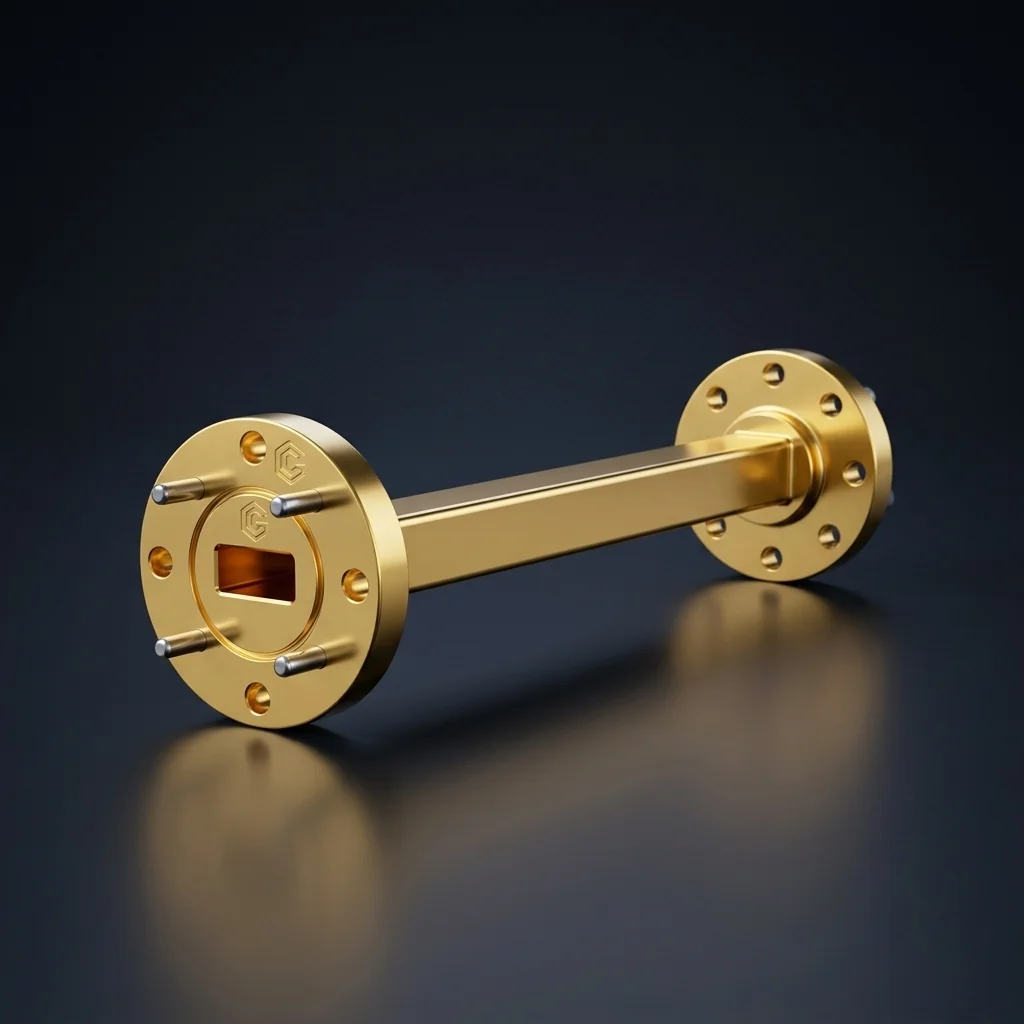
WR-22 Straight Waveguide
The WR-22 Straight Waveguide is a precision-engineered waveguide component that provides ultra-low loss linear signal transmission for bridging gaps in RF systems. It is specifically designed for the 33 - 50 GHz frequency range, serving as a critical building block in Q-Band infrastructure.
Straight waveguide sections are drawn or electroformed to exact tolerances, providing a pure, unperturbed environment for dominant TE10 mode propagation over fixed distances. WR-22 operates in the Q-Band (33-50 GHz), sitting right above the Ka-band. Its 0.224" x 0.112" aperture requires precise CNC machining, as surface roughness begins to significantly impact insertion loss at these frequencies.
Key Features
Low Insertion Loss
Engineered for minimal insertion loss and excellent Voltage Standing Wave Ratio (VSWR) across the full Q-Band.
Gold Plated Finish
Gold plating provides superior corrosion resistance and ensures long-term signal reliability in demanding environments.
OFHC Copper Body
Oxygen-free high conductivity copper waveguide body with precision-machined brass flanges for superior performance.
Custom Lengths
Available in standard lengths. Custom dimensions manufactured to your exact system requirements on request.
Common Use Cases
Radio Astronomy
Molecular cloud mapping
Q-Band Satcom
Next-gen broadband links
Military Data
High-capacity secure comms
Test Equipment
Vector network analysis
More Straight Waveguides
Frequently Asked Questions
Why use a straight waveguide instead of coaxial cable?+
At millimeter-wave frequencies, coaxial cables suffer from extreme dielectric loss and radiation leakage. A hollow straight waveguide removes the center conductor and dielectric, reducing insertion loss by over 80% compared to a coax cable.
What are the main applications for WR-22 Q-Band components?+
WR-22 is heavily utilized in advanced satellite communications (V-band/Q-band uplinks) to escape the congested Ka-band. It is also a critical band for radio astronomy, specifically for mapping complex molecules in deep space.
How does surface roughness affect WR-22?+
At 50 GHz, the skin depth of copper is incredibly thin (less than 0.3 micrometers). If the interior machining marks of the WR-22 component are larger than the skin depth, the RF current is forced to travel up and down the microscopic ridges, exponentially increasing resistive heating and insertion loss.