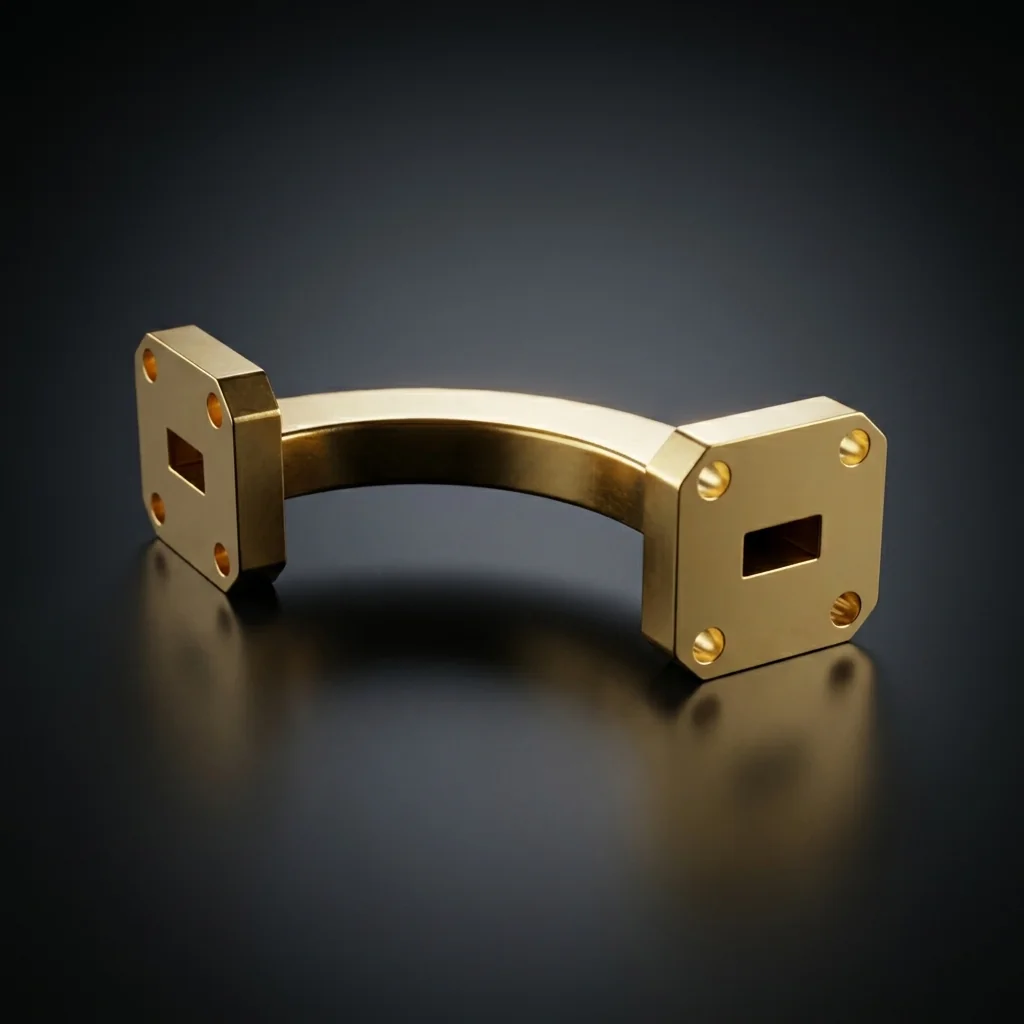
WR-22 H-Plane Bend
The WR-22 H-Plane Bend is a precision-engineered waveguide component that redirects millimeter-wave signals by 90 degrees in the broad wall (H-field) plane. It is specifically designed for the 33 - 50 GHz frequency range, serving as a critical building block in Q-Band infrastructure.
H-plane bends curve along the wider dimension of the rectangular waveguide cross-section, providing horizontal signal routing without inducing higher-order modes. WR-22 operates in the Q-Band (33-50 GHz), sitting right above the Ka-band. Its 0.224" x 0.112" aperture requires precise CNC machining, as surface roughness begins to significantly impact insertion loss at these frequencies.
Key Features
H-Plane Geometry
Bend follows the broad wall (wider dimension) of the waveguide, routing signals horizontally while maintaining the narrow-wall dimension.
Low Insertion Loss
Optimized bend radius and CNC-machined interior walls ensure minimal signal degradation through the 90-degree turn.
Precision CNC Machined
Each bend is machined from a solid billet of OFHC copper, maintaining tight dimensional tolerances throughout the bend radius.
Gold-Plated Construction
Gold plating provides excellent conductivity, corrosion resistance, and consistent electrical performance over the component's service life.
Q-Band Use Cases
Radio Astronomy
Molecular cloud mapping
Q-Band Satcom
Next-gen broadband links
Military Data
High-capacity secure comms
Test Equipment
Vector network analysis
More H-Plane Bends
Frequently Asked Questions
Why use an H-plane bend over an E-plane bend?+
H-plane bends are used when the signal needs to be routed horizontally across an optical table or chassis without twisting the polarization of the wave. The wider bend radius typically handles higher peak power than an E-plane bend.
What are the main applications for WR-22 Q-Band components?+
WR-22 is heavily utilized in advanced satellite communications (V-band/Q-band uplinks) to escape the congested Ka-band. It is also a critical band for radio astronomy, specifically for mapping complex molecules in deep space.
How does surface roughness affect WR-22?+
At 50 GHz, the skin depth of copper is incredibly thin (less than 0.3 micrometers). If the interior machining marks of the WR-22 component are larger than the skin depth, the RF current is forced to travel up and down the microscopic ridges, exponentially increasing resistive heating and insertion loss.