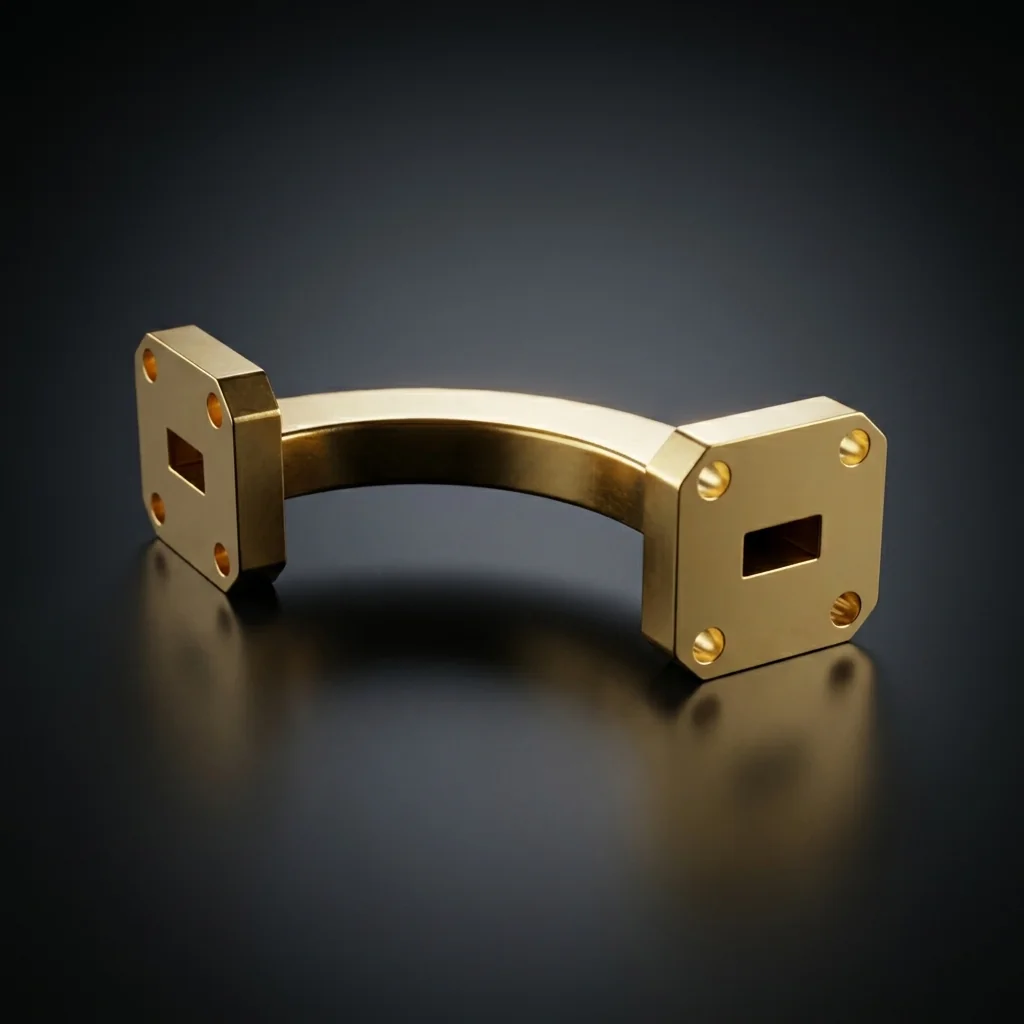
WR-12 H-Plane Bend
The WR-12 H-Plane Bend is a precision-engineered waveguide component that redirects millimeter-wave signals by 90 degrees in the broad wall (H-field) plane. It is specifically designed for the 60 - 90 GHz frequency range, serving as a critical building block in E-Band infrastructure.
H-plane bends curve along the wider dimension of the rectangular waveguide cross-section, providing horizontal signal routing without inducing higher-order modes. Operating in the 60-90 GHz E-Band, WR-12 is the backbone of modern 71-86 GHz high-capacity telecom links. The tiny 0.122" x 0.061" aperture requires anti-cocking flanges to prevent catastrophic misalignment.
Key Features
H-Plane Geometry
Bend follows the broad wall (wider dimension) of the waveguide, routing signals horizontally while maintaining the narrow-wall dimension.
Low Insertion Loss
Optimized bend radius and CNC-machined interior walls ensure minimal signal degradation through the 90-degree turn.
Precision CNC Machined
Each bend is machined from a solid billet of OFHC copper, maintaining tight dimensional tolerances throughout the bend radius.
Gold-Plated Construction
Gold plating provides excellent conductivity, corrosion resistance, and consistent electrical performance over the component's service life.
E-Band Use Cases
E-Band Backhaul
71-86 GHz point-to-point
Telecom Backbone
Fiber-optic extension
Collision Avoidance
Advanced vehicular radar
High-Res Imaging
Security scanning systems
More H-Plane Bends
Frequently Asked Questions
Why use an H-plane bend over an E-plane bend?+
H-plane bends are used when the signal needs to be routed horizontally across an optical table or chassis without twisting the polarization of the wave. The wider bend radius typically handles higher peak power than an E-plane bend.
Why is WR-12 critical for telecom backhaul?+
The FCC opened the 71-76 GHz and 81-86 GHz bands for ultra-high-capacity point-to-point microwave links. WR-12 components are the physical standard for routing these E-Band signals from the transceiver to the parabolic dish, enabling 10+ Gbps data rates where fiber is too expensive to lay.
What is an anti-cocking flange on WR-12?+
At E-Band frequencies, if a flange is bolted together unevenly (cocked), the microscopic gap will leak massive amounts of RF energy and ruin the VSWR. Anti-cocking flanges have an outer rim that guarantees the mating surfaces remain perfectly parallel during tightening.