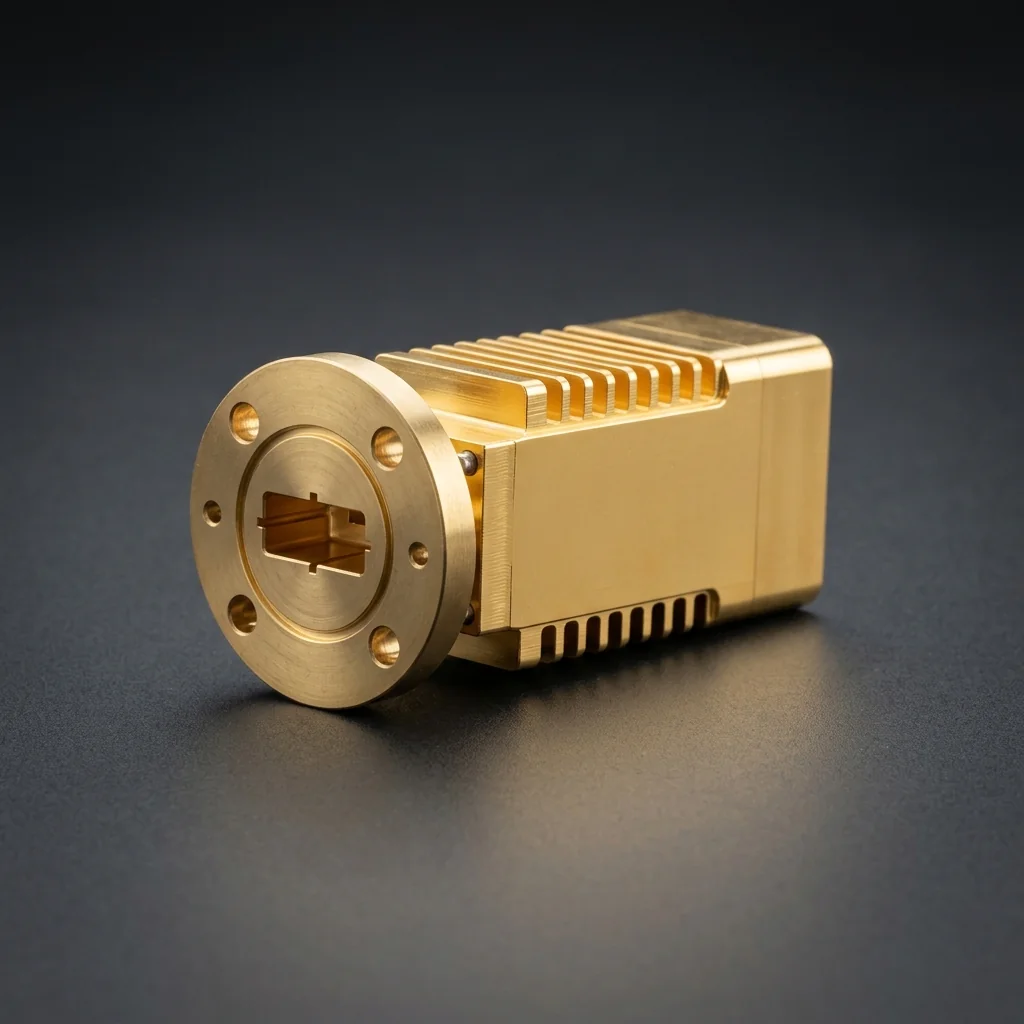
WR-22 Medium Power Termination
The WR-22 Medium Power Termination is a precision-engineered waveguide component that absorbs moderate RF energy, providing a perfect 50-ohm (normalized) match to prevent reflections. It is specifically designed for the 33 - 50 GHz frequency range, serving as a critical building block in Q-Band infrastructure.
Medium-power terminations utilize a precision-tapered lossy dielectric wedge that gradually absorbs the RF wave over several wavelengths, preventing any sudden impedance steps. WR-22 operates in the Q-Band (33-50 GHz), sitting right above the Ka-band. Its 0.224" x 0.112" aperture requires precise CNC machining, as surface roughness begins to significantly impact insertion loss at these frequencies.
Key Features
Broadband Coverage
Full-band performance across the complete operating frequency range with consistent impedance matching.
Moderate Power Handling
Enhanced absorptive element with improved thermal capacity for sustained operation under moderate power conditions.
Production Ready
Built for reliability in automated production test lines and system integration environments.
Field Deployable
Compact enough for field applications while exceeding the power handling capability of low power loads.
Q-Band Use Cases
Radio Astronomy
Molecular cloud mapping
Q-Band Satcom
Next-gen broadband links
Military Data
High-capacity secure comms
Test Equipment
Vector network analysis
More Medium Power Terminations
Frequently Asked Questions
How is VSWR minimized in a termination?+
The absorbing element is machined into a sharp spear or wedge shape. When the RF wave hits the tip, it sees almost empty space. As it travels deeper, the wedge gets thicker, gradually absorbing the power so no distinct "wall" ever bounces the signal back.
What are the main applications for WR-22 Q-Band components?+
WR-22 is heavily utilized in advanced satellite communications (V-band/Q-band uplinks) to escape the congested Ka-band. It is also a critical band for radio astronomy, specifically for mapping complex molecules in deep space.
How does surface roughness affect WR-22?+
At 50 GHz, the skin depth of copper is incredibly thin (less than 0.3 micrometers). If the interior machining marks of the WR-22 component are larger than the skin depth, the RF current is forced to travel up and down the microscopic ridges, exponentially increasing resistive heating and insertion loss.