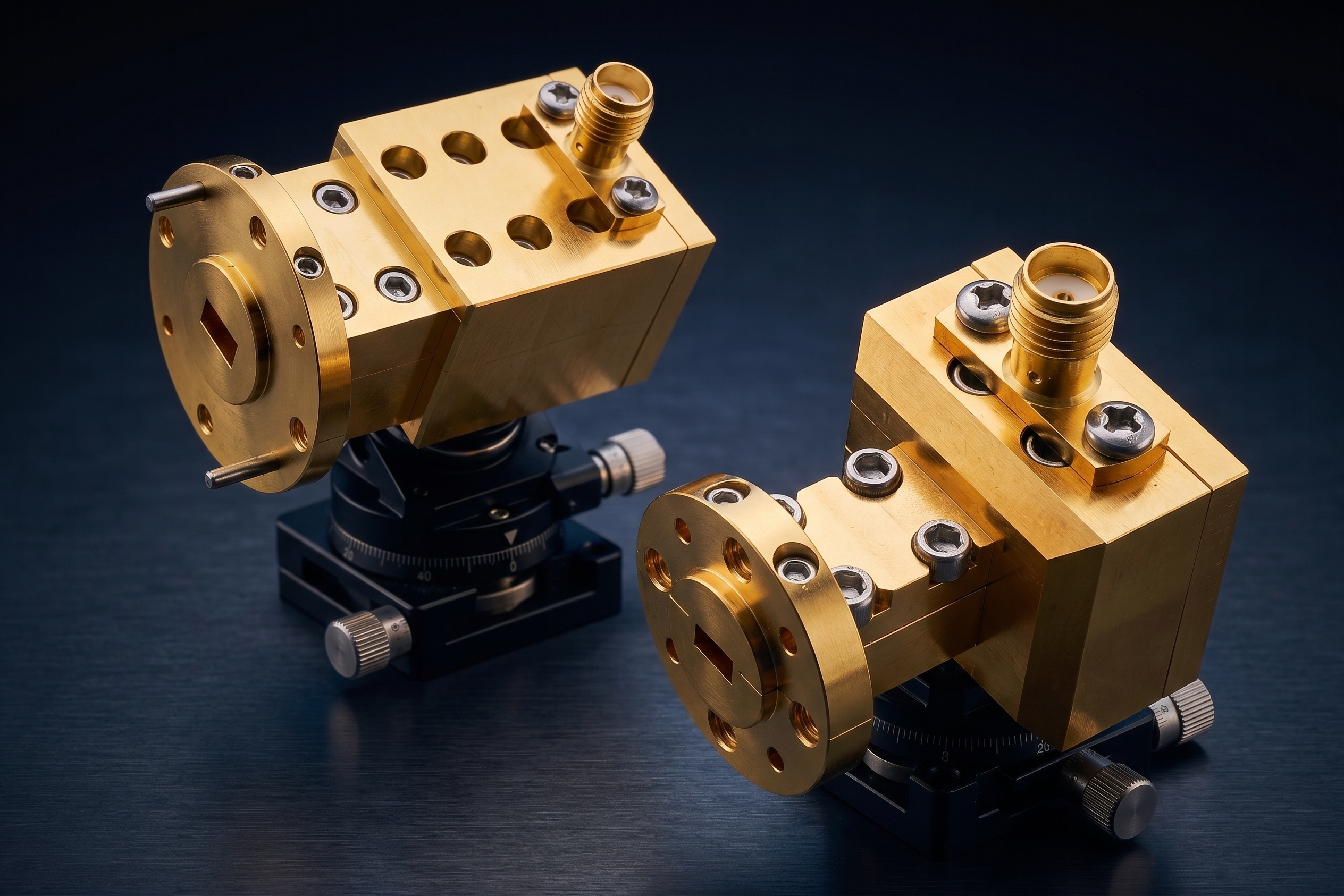
Millimeter-Wave
Mixers
Harmonic, wideband balanced, and I/Q mixer topologies from 26.5 GHz to 220 GHz. Schottky barrier diode designs for downconversion, upconversion, and signal analysis across Ka through G-band waveguide interfaces.
Mixer Products by Topology
Harmonic Mixers
Schottky barrier diode harmonic mixers for downconverting millimeter-wave signals. Measurements are made by mixing the harmonic of the LO (2 to 20 GHz) with the desired RF signal. Recommended for use with a harmonic number less than 14.
| Waveguide | RF Frequency | LO Range | LO Power | Conversion Loss | IF Output | Harmonic No. |
|---|---|---|---|---|---|---|
| WR-28 | 26.5 – 40 GHz | 2 – 20 GHz | +10 dBm | 20 – 30 dB typ. | DC – 3 GHz | < 14 |
| WR-22 | 33 – 50 GHz | 2 – 20 GHz | +10 dBm | 20 – 30 dB typ. | DC – 3 GHz | < 14 |
| WR-19 | 40 – 60 GHz | 2 – 20 GHz | +10 dBm | 20 – 30 dB typ. | DC – 3 GHz | < 14 |
| WR-15 | 50 – 75 GHz | 2 – 20 GHz | +10 dBm | 20 – 30 dB typ. | DC – 3 GHz | < 14 |
| WR-12 | 60 – 90 GHz | 2 – 20 GHz | +10 dBm | 20 – 30 dB typ. | DC – 3 GHz | < 14 |
| WR-10 | 75 – 110 GHz | 2 – 20 GHz | +10 dBm | 20 – 30 dB typ. | DC – 3 GHz | < 14 |
| WR-08 | 90 – 140 GHz | 2 – 20 GHz | +10 dBm | 25 – 35 dB typ. | DC – 3 GHz | < 14 |
| WR-06 | 110 – 170 GHz | 2 – 20 GHz | +10 dBm | 25 – 35 dB typ. | DC – 3 GHz | < 14 |
| WR-05 | 140 – 220 GHz | 2 – 20 GHz | +10 dBm | 30 – 40 dB typ. | DC – 3 GHz | < 14 |
Harmonic Mixers with Diplexer
Harmonic mixers with an optional LO-IF frequency diplexer for simplified test setups. Schottky barrier diode design for downconverting millimeter-wave signals. Recommended for use with a harmonic number less than 14.
| Waveguide | RF Frequency | LO Range | LO Power | IF Output | Conversion Loss | Diplexer |
|---|---|---|---|---|---|---|
| WR-28 | 26.5 – 40 GHz | 4 – 20 GHz | +12 dBm | DC – 3 GHz | 20 – 30 dB typ. | LO-IF Integrated |
| WR-22 | 33 – 50 GHz | 4 – 20 GHz | +12 dBm | DC – 3 GHz | 20 – 30 dB typ. | LO-IF Integrated |
| WR-19 | 40 – 60 GHz | 4 – 20 GHz | +12 dBm | DC – 3 GHz | 20 – 30 dB typ. | LO-IF Integrated |
| WR-15 | 50 – 75 GHz | 4 – 20 GHz | +12 dBm | DC – 3 GHz | 20 – 30 dB typ. | LO-IF Integrated |
| WR-12 | 60 – 90 GHz | 4 – 20 GHz | +12 dBm | DC – 3 GHz | 20 – 30 dB typ. | LO-IF Integrated |
| WR-10 | 75 – 110 GHz | 4 – 20 GHz | +12 dBm | DC – 3 GHz | 20 – 30 dB typ. | LO-IF Integrated |
| WR-08 | 90 – 140 GHz | 4 – 20 GHz | +12 dBm | DC – 3 GHz | 25 – 35 dB typ. | LO-IF Integrated |
| WR-06 | 110 – 170 GHz | 4 – 20 GHz | +12 dBm | DC – 3 GHz | 25 – 35 dB typ. | LO-IF Integrated |
| WR-05 | 140 – 220 GHz | 4 – 20 GHz | +12 dBm | DC – 3 GHz | 30 – 40 dB typ. | LO-IF Integrated |
Wideband Balanced Mixers
Balanced mixer down-converters and up-converters designed to cover extremely wide RF bandwidths for EW/ELINT applications. Biased mixer options with lower LO drive are available.
| Waveguide | RF Frequency | IF Range | Conversion Loss | LO/RF Isolation | Topology | Application |
|---|---|---|---|---|---|---|
| WR-28 | 26.5 – 40 GHz | DC – 20 GHz | 10 dB | ≥ 20 dB | Double Balanced | EW / ELINT |
| WR-22 | 33 – 50 GHz | DC – 20 GHz | 10 dB | ≥ 20 dB | Double Balanced | EW / ELINT |
| WR-19 | 40 – 60 GHz | DC – 20 GHz | 10 dB | ≥ 20 dB | Double Balanced | EW / ELINT |
| WR-15 | 50 – 75 GHz | DC – 20 GHz | 8 dB | ≥ 20 dB | Double Balanced | EW / ELINT |
| WR-12 | 60 – 90 GHz | DC – 20 GHz | 10 dB | ≥ 20 dB | Double Balanced | EW / ELINT |
| WR-10 | 75 – 110 GHz | DC – 20 GHz | 12 dB | ≥ 20 dB | Double Balanced | EW / ELINT |
I/Q Mixers
In-phase and quadrature (I/Q) output mixers covering DC to 110 GHz RF. Good LO-to-RF isolation over a broad frequency range. Typical IF range is DC to 5 GHz. Both waveguide and coaxial interfaces available.
| Waveguide | RF Frequency | IF Range | Conversion Loss | LO/RF Isolation | I/Q Amplitude Balance | I/Q Phase Balance |
|---|---|---|---|---|---|---|
| WR-28 | 26.5 – 40 GHz | DC – 5 GHz | 10 dB | 28 dB | ± 1 dB | ± 5° |
| WR-22 | 33 – 50 GHz | DC – 5 GHz | 10 dB | 28 dB | ± 1 dB | ± 5° |
| WR-19 | 40 – 60 GHz | DC – 5 GHz | 10 dB | 28 dB | ± 1 dB | ± 5° |
| WR-15 | 50 – 75 GHz | DC – 5 GHz | 10 dB | 28 dB | ± 1.5 dB | ± 5° |
| WR-12 | 60 – 90 GHz | DC – 5 GHz | 10 dB | 28 dB | ± 1.5 dB | ± 5° |
| WR-10 | 75 – 110 GHz | DC – 5 GHz | 10 dB | 28 dB | ± 2 dB | ± 8° |
All specifications are typical values. Custom frequency plans, IF ranges, and packaging options available. Contact engineering for detailed datasheets and custom configurations.
Need a custom mixer configuration?
Our engineering team builds mixers to your exact frequency, topology, and interface requirements. Custom waveguide bands, IF ranges, and packaging options available.
Frequently Asked Questions
A harmonic mixer uses higher-order harmonics of the local oscillator to downconvert millimeter-wave signals, allowing a lower-frequency LO source (typically 2 to 20 GHz) to reach RF frequencies above 100 GHz. This simplifies the LO chain but introduces higher conversion loss. A balanced mixer uses a pair of matched diodes in a hybrid junction to cancel LO noise and suppress even-order spurious products, providing lower conversion loss and better port isolation at the expense of requiring a higher LO drive level at the target RF frequency.
RF Essentials millimeter-wave mixers cover RF frequencies from 26.5 GHz to 220 GHz depending on the topology. Harmonic mixers span 26.5 to 220 GHz using waveguide bands WR-28 through WR-05. Wideband balanced mixers cover 26.5 to 110 GHz. I/Q mixers operate from 26.5 to 110 GHz with in-phase and quadrature outputs.
An I/Q (in-phase/quadrature) mixer produces two IF outputs separated by 90 degrees of phase. This enables single-sideband signal recovery, image rejection, and direct complex demodulation without external filtering. I/Q mixers are used in vector signal analyzers, digital receivers, radar systems, and modern communication architectures where both amplitude and phase information must be preserved during frequency translation.